US federal courts: authentication and other rules
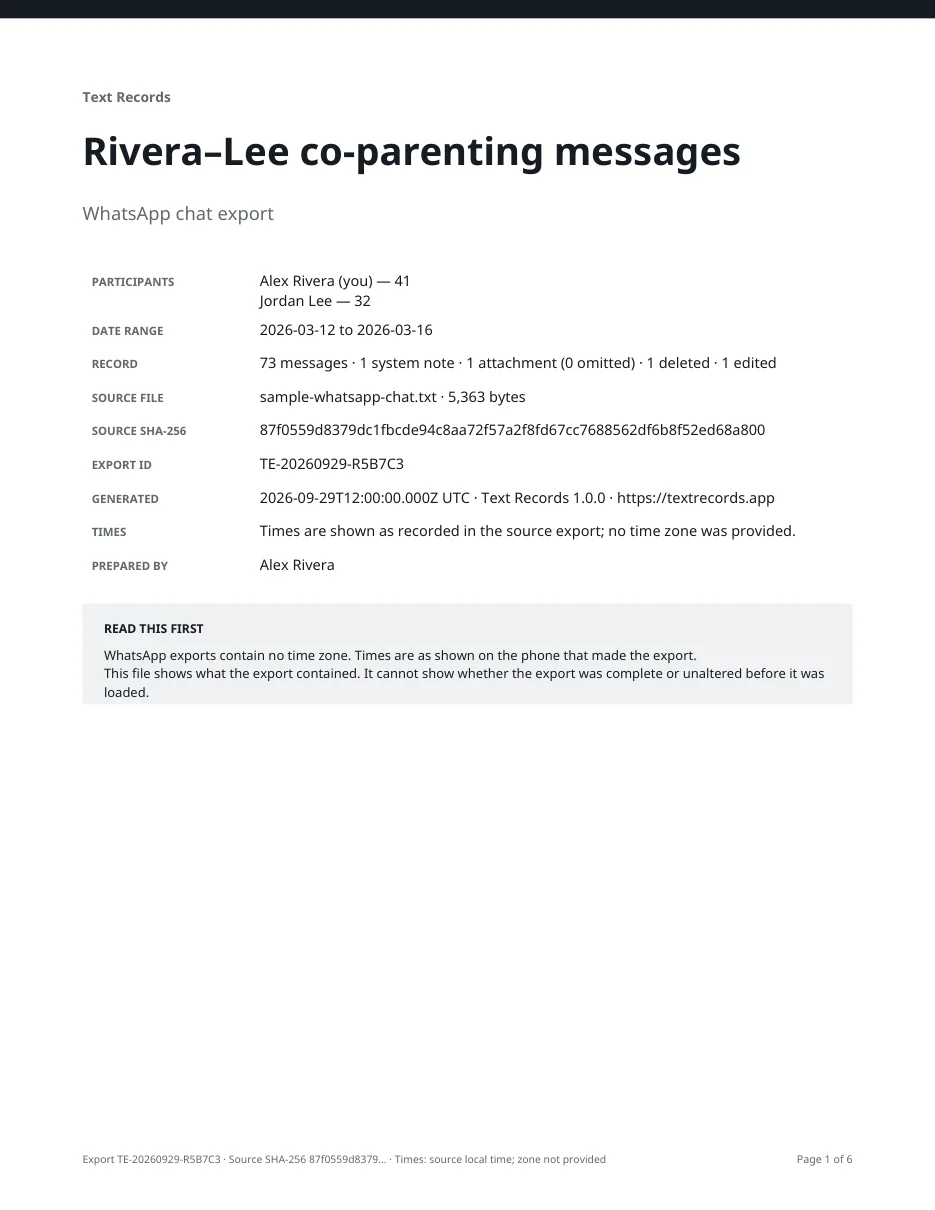
An export needs a foundation. FRE 901 asks for enough evidence to support a finding that the item is what you claim. Its Notes explain that authentication does not resolve other barriers, including hearsay.
Rules 1001–1004 address proving content. An accurate readable electronic output can be an original. A duplicate is generally permitted unless there is a genuine authenticity question or its use would be unfair. Rule 1004 allows other evidence in specified circumstances, including originals lost or destroyed without the offering party’s bad faith. That is not a reason to discard the source.
US state family courts: local rules
Federal rules are a useful comparison, not a substitute for each state’s own rules. In California, Evidence Code 1400–1402 requires authentication and an explanation of material alterations. Section 1521 allows otherwise permitted secondary evidence, with exclusions for certain material disputes or unfairness. Section 1552 presumes a printed representation of computer information is accurate, but that presumption can be challenged. It does not prove authorship.
California’s domestic violence hearing guidance lists texts as evidence to gather and says to make three copies of documents. That instruction is for those hearings, not a universal three-copy rule.
The Texas Rules of Evidence also recognize accurate readable electronic originals (1001) and knowledgeable witnesses, distinctive characteristics and accurate processes (901). Texas 1003 says a question about authenticity, rather than the federal rule’s a genuine question. Rules 106–107 address surrounding material needed for fairness or explanation. Follow the actual hearing directions; see also custody and divorce texts.
England & Wales civil courts: copies and disclosure
CEA section 8 allows a document or copy authenticated in a manner the court approves. Section 13 defines documents and copies broadly, not just as paper or screenshots.
But a readable hearing PDF may not meet disclosure requirements. CPR Part 31 covers disclosure and inspection and excludes small claims. Its standard disclosure includes documents that adversely affect a party’s case as well as supporting documents. PD 31B normally applies to multi-track cases. It includes texts and metadata, requires preservation once litigation is contemplated, and normally calls for native electronic copies preserving creation-date metadata unless agreed or ordered otherwise. Available OCR text accompanies the original; it is not a guaranteed accurate replacement (paragraphs 7, 33–35).
CPR 32.19 treats authenticity of Part 31 disclosed documents as admitted unless a timely notice to prove is served. That does not make the contents true. Under CPR 32 and PD 32, witness statements and exhibits have their own requirements. A transcript is an exhibit, not a substitute for a signed witness statement explaining what the witness knows.
England & Wales family courts: bundle rules
FPR Part 22 gives the court control of evidence and sets witness-statement requirements. Documents are generally introduced through a witness statement rather than speaking for themselves.
The PD 27A text effective March 2, 2026 makes e-bundles the default, subject to directions and exceptions. Paragraph 5.2 says routine texts and other social communications should not be included as a class unless directed otherwise. It expressly allows specific documents that are necessary to read or will actually be referred to. Preserve the full source; select the necessary hearing documents.
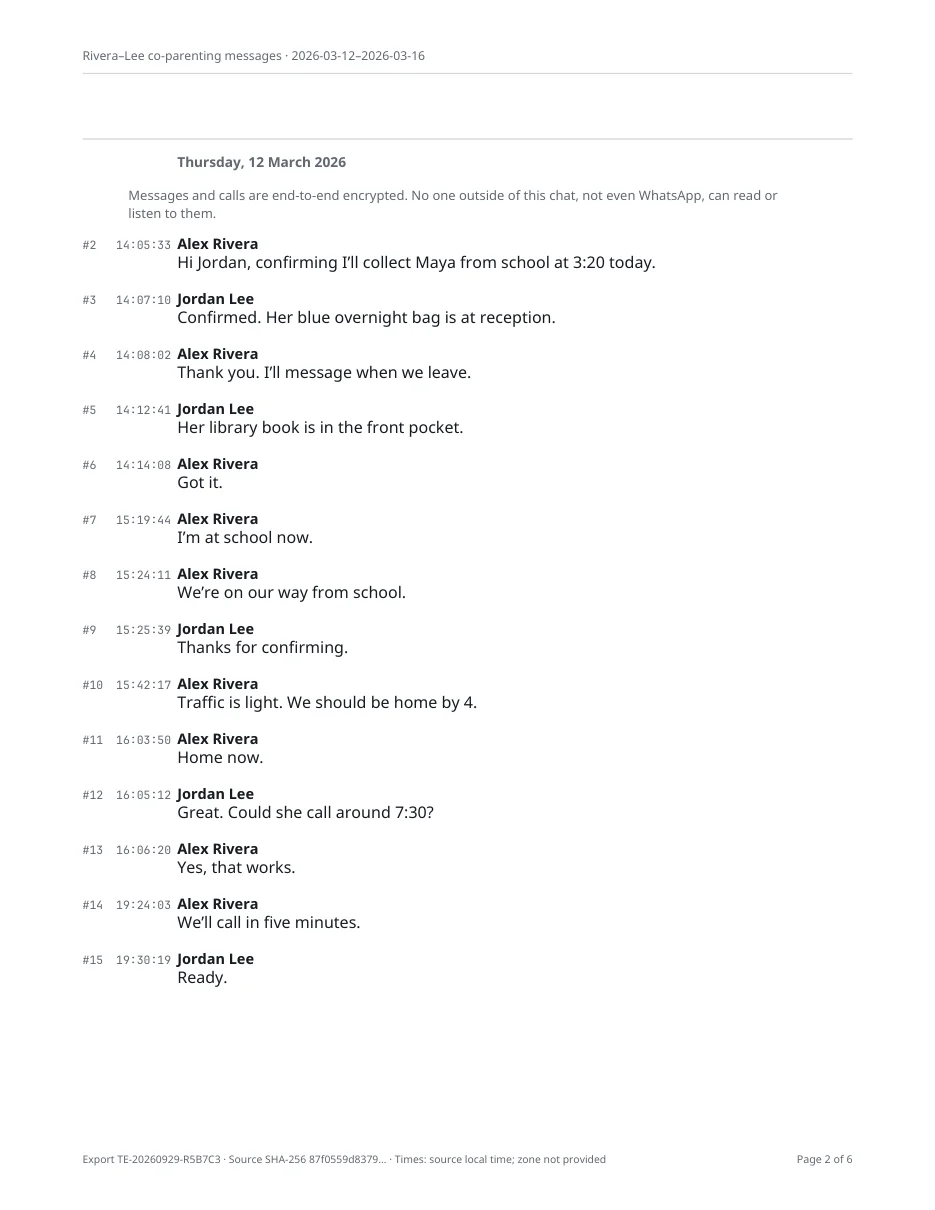
The normal e-bundle limit is 350 pages, not a quota to fill. The usual 25-page witness-statement limit excludes exhibits; it is not a limit on all chat evidence. E-bundle numbering, bookmarks and searchable text have separate requirements (paragraphs 8.1 and 11.2). Source-position message numbers do not replace those requirements.
Employment tribunals: the shared bundle
The official employment tribunal hearing guidance says to disclose relevant documents whether or not they support the party’s case. The needed hearing documents go into a single page-numbered, indexed bundle, electronic and/or paper. Witness statements are exchanged and witnesses should attend. Each case also has its own directions. A chat PDF can contribute to that bundle; it is not the whole bundle or proof of the sender.
Canada: electronic documents and provincial rules
The Canada Evidence Act applies to criminal proceedings and to civil proceedings and other matters under federal jurisdiction (section 2). Section 40 applies the evidence law of the province where those proceedings take place, subject to federal law. Provincial civil, family and small claims cases follow the province’s own Evidence Act and court rules.
Sections 31.1 to 31.8 deal with electronic documents, which include texts and chat messages:
- Authentication (s. 31.1): the person offering the messages must give evidence capable of supporting a finding that they are what they claim to be. In R. v. Martin, 2021 NLCA 1, the Newfoundland and Labrador Court of Appeal summarized this as a low standard of “some evidence” (para. 43), following the Ontario Court of Appeal in R. v. C.B., 2019 ONCA 380.
- Best evidence (s. 31.2): met by proof of the integrity of the system that recorded or stored the messages. A printout can also meet it if it has been “manifestly or consistently acted on, relied on or used as a record” of the information.
- Presumed integrity (s. 31.3): without evidence to the contrary, integrity is proven by evidence capable of supporting a finding that the phone or computer was working properly, or if the record was stored by the opposing party, or by a non-party in the usual course of business.
- Affidavits (s. 31.6): these matters can be proved by affidavit, and the other side may be able to cross-examine on it.
- Other rules still apply (s. 31.7): these sections change only the rules on authentication and best evidence.
Ontario’s Evidence Act, s. 34.1 sets the same authentication burden and best-evidence test for electronic records in Ontario cases, and adds that integrity can be shown by evidence that reliable encryption was used. Other provinces have their own Evidence Acts. Check the one for the court hearing your case, and follow its rules on affidavits, exhibits and disclosure.
Keep the phone and the full conversation, so someone who took part in it can say where the pages came from and answer questions about them.
How texts get challenged or excluded
The phrase “thrown out” hides several different questions. The other side may dispute the record itself, ask for more context or object to the purpose for which a statement is offered. A challenge is not an automatic exclusion.
- Authenticity: Does the foundation identify this conversation and explain the copy? A contact label, polished layout or checksum alone does not settle it. See FRE 901.
- Accuracy and fairness: Does the copy omit or change something material? FRE 1003 and its Notes address disputed originals and unfair duplicates, including partial reproduction where context matters.
- Completeness: Under the current FRE 106, the opponent may require another part or another statement to be considered at the same time when fairness requires, even over a hearsay objection. This is not a right to add every unrelated message. Texas has its own Rules 106–107.
- Hearsay: FRE 801 defines an out-of-hearing statement offered for its truth. A message offered to show notice was given raises a different question from the same words offered to prove the reported event happened. Rule 801(d)(2) excludes qualifying opposing-party statements from hearsay; it does not exempt every line of every chat. Ask a lawyer about the purpose and route for each disputed statement.
These federal examples are not the hearsay rules for every state or for England and Wales. This page does not cover criminal procedure there. Changing or deleting evidence can itself have serious consequences; a lawyer or legal aid service can advise on specific proceedings.
When the phone itself is evidence
There is no blanket phone-only rule in the sources summarized here. FRE 1001(d) and Texas 1001(d) allow accurate readable electronic outputs to count as originals. CEA s.8 supplies a civil copy route in England and Wales.
Originals still matter for checks. PD 32, paragraph 13.1 allows photocopy exhibits with originals available for inspection before the hearing and by the judge at it. Device inspection, where it happens, is arranged under the court’s directions and can be limited in scope.